
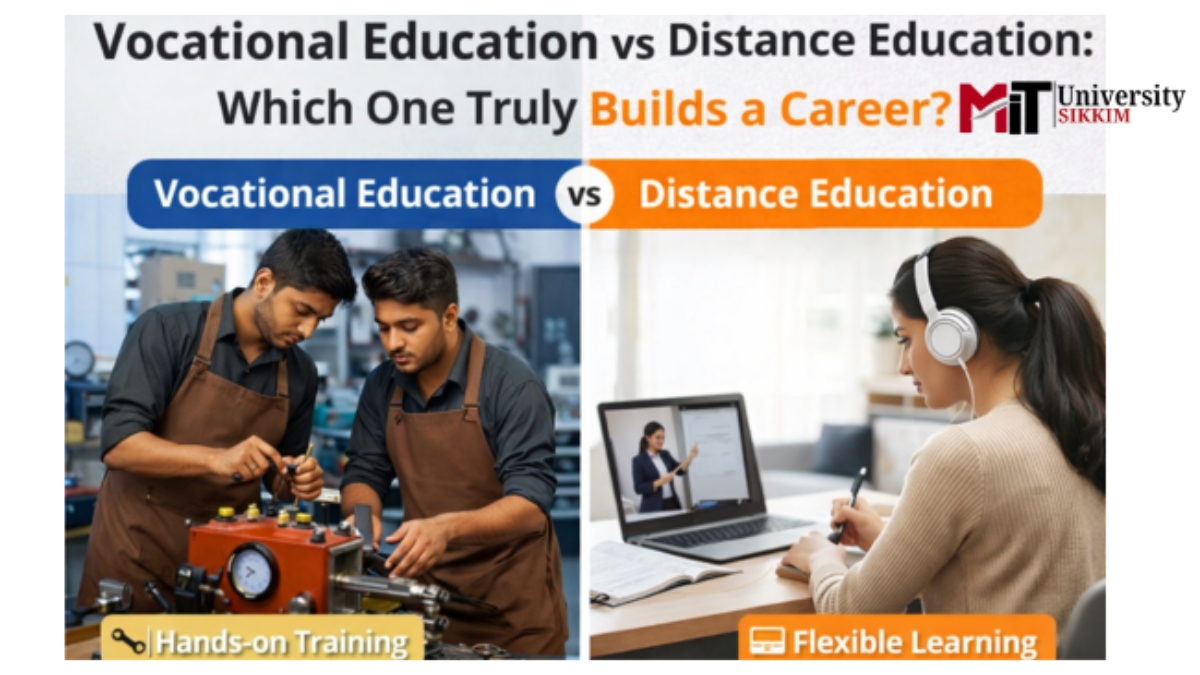
New Delhi [India], January 22: In a significant revelation that could reshape career decisions for millions of Indian youth, industry experts and education analysts have unanimously declared vocational education as 10 times more effective than distance education in building sustainable careers and ensuring immediate employability.
Several educational institutions, including MIT University Sikkim, one of the best university in north east, have shifted their focus towards skill-based vocational programmes after observing the stark difference in graduate employability outcomes compared to traditional learning models.
Recent data from the National Skill Development Corporation (NSDC) shows that 85 per cent of vocational education graduates secure employment within three months of course completion, compared to a mere 35-40 per cent placement rate for distance education graduates.
“The difference is stark and undeniable. Vocational education delivers job-ready professionals while distance education produces certificate holders with limited practical skills,” said Rajesh Kumar Sharma, Senior Industry Analyst at the Confederation of Indian Industry (CII).
Hands-On Training Makes the Difference
The primary advantage of vocational education lies in its practical, skill-based approach. Unlike distance education, which relies heavily on theoretical knowledge and self-study, vocational programmes provide hands-on training, live projects, and industry internships that prepare students for real-world challenges.
Priya Mehta, HR Director at a leading manufacturing firm, told ANI: “We have stopped considering distance education candidates for technical roles. They lack practical exposure. Vocational graduates, however, can start contributing from day one.”
Government’s Strong Support
The Ministry of Skill Development and Entrepreneurship has been aggressively promoting vocational education under the Skill India Mission, with over 1.5 crore youth trained across various sectors including healthcare, IT, hospitality, automotive, and manufacturing.
National Education Policy (NEP) 2020 has set an ambitious target of providing 50 per cent of youth with vocational skills by 2025, recognising it as the key driver of India’s economic growth and employment generation.
Industry Demand and Skill Gap
India currently faces a massive skill shortage across critical sectors. The healthcare industry needs 2.5 million trained professionals, IT sector requires 1.8 million skilled workers, and the automotive industry has a demand for 900,000 technicians.
“This gap cannot be filled by distance education graduates who lack hands-on competence. Only vocational training can address this crisis,” stated Dr Anjali Verma, Vocational Training Expert and former AICTE official.
Success Stories
-
Vikram Singh (24), a vocational diploma holder in electrical technology, now earns Rs 45,000 per month as a senior technician. “My cousin spent three years on distance education and is still jobless. I trained for 18 months and got immediate placement,” he shared.
-
Similarly, Neha Gupta, who completed vocational training in healthcare management, now manages operations at a 200-bed hospital. “Practical exposure during training gave me real-world confidence that no distance course could provide,” she said.
Educational experts and career counsellors are now advising students to prioritise vocational education over distance learning for better career prospects.
“If employability is your goal, vocational education is the only logical choice. It’s faster, more effective, and delivers tangible career outcomes,” concluded Suresh Patel, Career Guidance Expert.
With NSDC-certified programmes, industry partnerships, and guaranteed placement support, vocational education has emerged as India’s most powerful tool for youth empowerment and economic development.
The message is clear: skill-based vocational training is not just better—it’s 10 times better than distance education for building real careers.
If you have any objection to this press release content, kindly contact [email protected] to notify us. We will respond and rectify the situation in the next 24 hours.