 Divya Agarwal
New Delhi [India], June 17: For much of the past two decades, Talegaon occupied a peripheral role in Pune’s real estate imagination. It was where the expressway passed through, where JCB assembled its excavators, and where weekend home buyers occasionally ventured. That description no longer holds. A convergence of infrastructure investment, industrial policy, and residential demand is rewriting Talegaon’s identity at speed – and the data makes a compelling case for those willing to look past the legacy narrative.
The Connectivity Dividend
Location has always been Talegaon’s understated advantage. Positioned squarely on the Mumbai–Pune Expressway and National Highway 48, it sits roughly equidistant between India’s two largest economic centres. What has changed is the density and quality of that connectivity.
The Maharashtra State Infrastructure Development Corporation (MSIDC) has received cabinet approval to upgrade the 53.2-km Talegaon–Chakan–Shikrapur corridor into a four-lane elevated highway and a six-lane at-grade road, at an estimated cost of Rs. 3,923.89 crore on the BOT model. Tenders were floated in late 2025, with construction timelines of two to two-and-a-half years.
Additionally, the Pune Ring Road – whose western section is targeted for completion by May 2027 – will directly benefit the Talegaon belt, connecting it to Hinjewadi IT Park, Lohegaon Airport, and PCMC without traversing city arteries. The Ring Road alone changes the commute calculus for the entire western corridor, reducing dependence on the congested Pune-Nashik axis.
Rail connectivity adds another dimension. Talegaon station on the Mumbai-Pune Central Railway line provides a functional, affordable commuter option that is almost entirely absent in comparable peri-urban industrial belts in the region.
The Defence Dimension
The most consequential recent development for Talegaon’s long-term trajectory is one that has received relatively little residential-market attention. As of early June 2026, the Maharashtra government has initiated plans to develop a 1,100-acre industrial park near Talegaon, with defence manufacturing explicitly identified as the primary growth driver.
This project is expected to generate approximately 50,000 jobs. This follows a structured pattern of defence-sector interest in the Pune–Maval corridor, which already houses precision engineering, electronics, and aerospace-ancillary manufacturers.
The significance for residential real estate is direct. Defence-sector employment is stable, relatively well-compensated, and – crucially – long-tenure. Workers and technicians drawn to such facilities do not commute from Shivajinagar or Hadapsar; they settle close to work. This is the demographic profile that sustains integrated residential communities.
Warehousing: The Emerging Anchor
Talegaon is increasingly consolidating its position as Pune’s primary warehousing and logistics hub. Welspun One’s announcement of a Rs.550 crore Grade-A logistics park on 46 MIDC-allotted acres in Talegaon MIDC Phase IV – comprising 1.2 million sq. ft. spread across four buildings – is among the more visible markers of this shift. ESR already operates a 60-acre, 1.35 million sq. ft. industrial and logistics park at Talegaon Phase II, serving automotive, FMCG, pharma, and e-commerce clients.
Pune’s overall warehousing market recorded approximately 7.4 million sq. ft. of leasing in 2025, a 10 per cent increase over the previous year. Notably, the Talegaon–Chakan corridor alone contributed nearly 70 per cent of this leasing activity. The Cabinet Committee on Economic Affairs has also approved a Multi-Modal Logistics Park (MMLP) for Talegaon, which would integrate road and rail freight handling and significantly reduce transit costs for exporters.
Together, these investments position Talegaon not merely as an industrial satellite of Pune but as a self-sustaining logistics region in its own right.
The Environment Edge
It is worth comparing Talegaon’s quality-of-life metrics with those of neighbouring industrial zones. Chakan MIDC, for over a decade the undisputed anchor of Pune’s industrial expansion, is now visibly struggling with the consequences of its own success.
A February 2025 investigation described Chakan as plagued by infrastructure failures, rising crime, and environmental concerns – citing broken internal roads, unregulated garbage burning generating toxic fumes, widespread encroachments, non-functional streetlights, and escalating extortion of industrialists.
Traffic congestion on the Pune-Nashik Road, Chakan’s primary artery, has by multiple accounts tripled commute times for workers. The then-Chief Minister Ajit Pawar publicly acknowledged the issues in 2025, noting among other problems the highest electricity tariff in the country and “negligible increase in new companies.”
Talegaon, benefiting from a lower base of industrial density and a greener, more undulated landscape, has not yet accumulated these pathologies. Its air quality, noise environment, and spatial character remain meaningfully superior. That is not a permanent condition – it is a window. How that window is used will determine whether Talegaon becomes a cautionary tale or a model.
Residential Appreciation: The Numbers
Property data indicates that select well-located townships within the Talegaon belt have logged appreciation of 80–90 per cent over the past five years – with real potential to reach 100 per cent or more by 2028–29, as infrastructure completions (Ring Road, elevated corridor, MMLP) catalyse a fresh demand cycle.
The apartment segment, which started from a lower base, has recorded annualised growth of approximately 9 per cent in recent periods. For a peri-urban location, these figures compare favourably – particularly when adjusted for the substantially lower entry price point relative to core Pune localities.
The Case for Integrated Townships
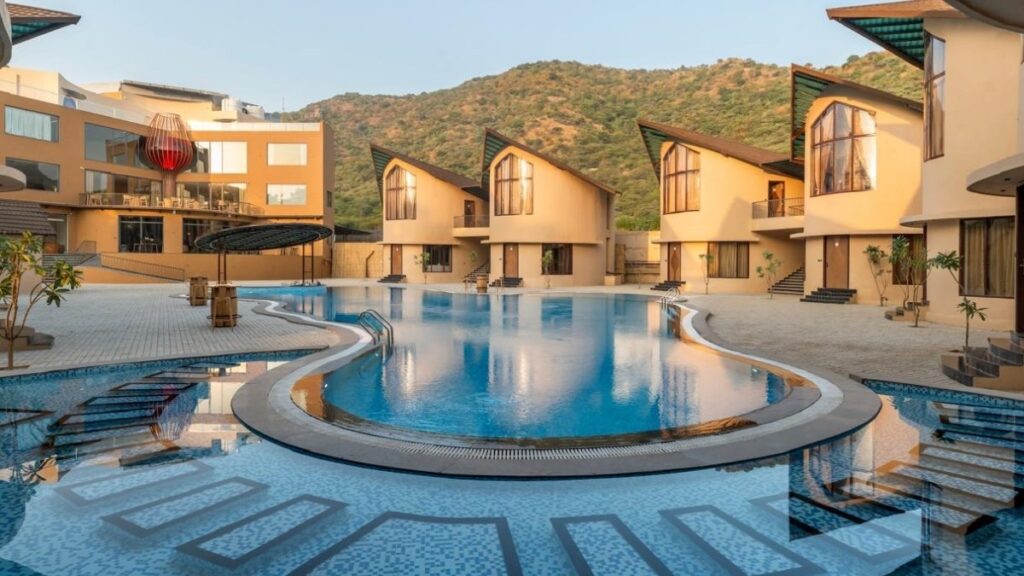
Within this emerging landscape, the question of development format deserves serious attention. Talegaon’s growth drivers – defence employment, logistics, manufacturing – create a specific residential demand profile: people who want to live near work, in communities that offer a full range of daily-life infrastructure without dependence on the nearest saturated city. That is, almost by definition, the integrated township model.
A standalone housing project in Talegaon, whatever its individual quality, cannot, on its own, provide schools, healthcare, recreational facilities, open green space, or commercial amenities at sufficient scale. It adds population without adding support infrastructure, which is precisely how areas like Chakan MIDC’s residential fringe deteriorated.
Integrated townships of sufficient scale can internalise these costs, create genuine communities, and maintain quality control over the built environment in their immediate precinct. In a market still in its early residential phase, the format of development sets the tone for everything that follows.
Maharashtra has recognised this. State policy actively encourages integrated township development, and the Pune Metropolitan Region has received approvals for over a dozen such projects. The policy logic is sound: structured planning compounds positively; ad-hoc development compounds negatively.
A Note of Caution
None of the above is an argument for complacency. Talegaon’s current appeal rests substantially on what it is not yet – not as congested, not as polluted, not as chaotic as the zones it borders. That is a fragile competitive advantage.
If the next phase of development consists primarily of small, fragmented, single-project launches – each rational individually but collectively generating density without the infrastructure to support it – Talegaon will have replicated exactly the errors it now benefits from. The infrastructure investment underway is necessary but not sufficient.
Equally important is planning discipline: adequate green cover, functional road widths, utility provisioning, and integrated community design. Talegaon is, in 2026, at precisely the inflection point where the right choices are still available. The question is whether enough stakeholders recognise this before the window closes.
If you object to the content of this press release, please notify us at [email protected]. We will respond and rectify the situation within 24 hours.