
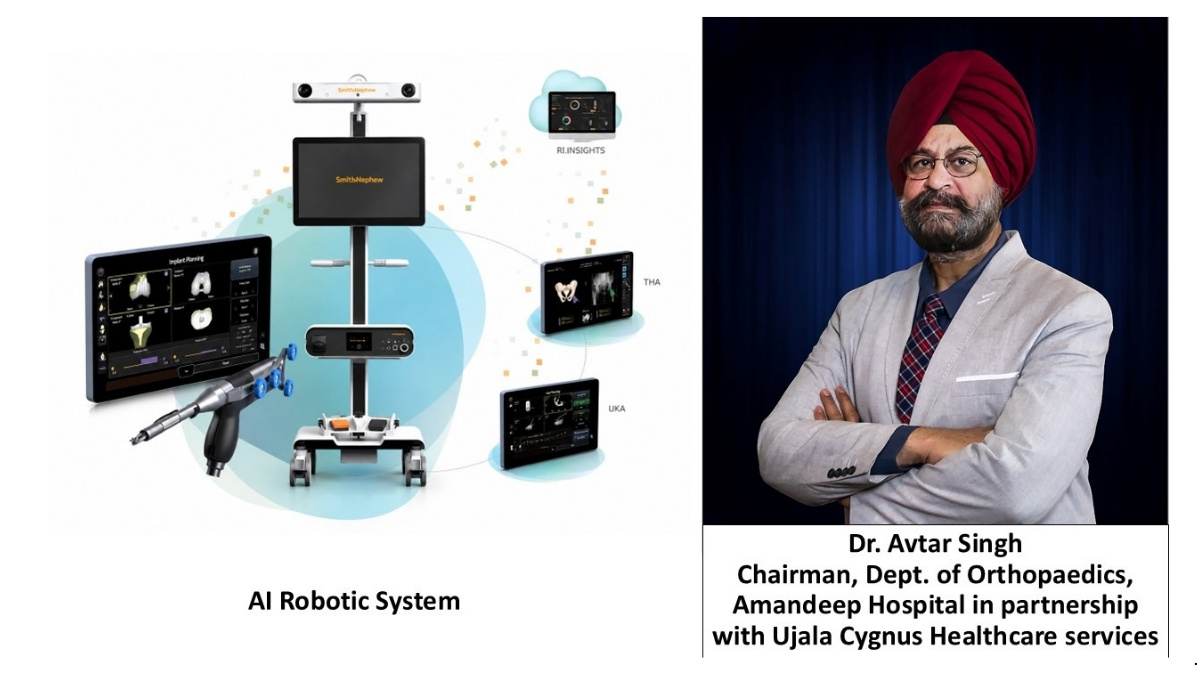
By Dr. Avtar Singh, Chief Orthopaedic & Robotic Joint Replacement Surgeon, Amandeep Hospitals, in partnership with Ujala Cygnus
Ludhiana (Punjab) [India], August 21: In the evolving landscape of healthcare, technology is no longer an accessory—it is the backbone of innovation and patient care. Among the many advancements in modern medicine, robotic-assisted surgery has emerged as a revolutionary force, especially in the field of joint replacement. As a practicing orthopaedic surgeon for over three decades and having led more than 25,000 joint replacements, I can say with conviction that robotics is not just the future—it is the present, reshaping outcomes for patients across India.
The Growing Need for Precision
India is witnessing a steep rise in cases of osteoarthritis, rheumatoid arthritis, and lifestyle-related joint damage. Longer life expectancy and increasing urbanization mean that more people are seeking mobility solutions at an earlier age. Traditional joint replacement techniques, though successful, often leave room for human error in alignment, implant positioning, and balancing. Even a few degrees of misalignment can significantly impact the longevity of an artificial joint.
This is where robotic technology steps in. With robotics, we are now able to achieve sub-millimeter precision in bone cuts and implant placement. The robot does not replace the surgeon, but it enhances the surgeon’s capability, allowing us to replicate natural joint mechanics with unparalleled accuracy.
How Robotics Transforms Joint Replacement
Robotic systems provide a 3D virtual mapping of the patient’s anatomy before surgery. This allows the surgeon to plan every cut and placement virtually before making the first incision. During surgery, the robot acts as a guiding arm, ensuring that execution follows the pre-planned path with utmost accuracy.
For patients, this translates into:
- Personalized joint replacement tailored to their unique anatomy.
- Minimal soft tissue damage due to controlled precision.
- Faster recovery and reduced hospital stay.
- Improved implant longevity, often lasting well beyond two decades.
At Amandeep Hospitals, in partnership with Ujala Cygnus, we have invested in cutting-edge Swiss and American robotic systems, ensuring that our patients receive global-standard care without having to travel abroad. Our latest ‘Advanced 3D printing, surgical planning and and Virtual Simulation centre’ is a great step towards providing customized implants for complex and revision cases.
A Patient-Centric Transformation
Behind every technological milestone, there is a human story. I recall the case of a 135 kg woman who came to us with severe deformities and immobility. Her case posed multiple challenges—traditional surgery could have left her vulnerable to complications. With robotic assistance, we not only corrected her deformities but also ensured that her implants were aligned perfectly to bear her weight. Within weeks, she was walking again, free of the pain that had bound her for years.
Stories like hers remind us that robotics is not about machines; it is about restoring dignity, independence, and hope. Each successful surgery reaffirms my belief that we are entering a new era where patients no longer just survive with implants—they thrive with them.
India’s Leap Forward
Globally, robotic joint replacement is becoming the gold standard, and India is not far behind. Our patients today are well-informed, often demanding the best that technology can offer. Hospitals like ours are bridging the gap by making robotics accessible and affordable.
Moreover, the learning curve for surgeons is shortening. With structured training, India is rapidly building a pool of robotic-trained orthopaedic surgeons who will carry this technology forward. This democratization of expertise ensures that robotics is not limited to metros but will soon be accessible in tier-2 and tier-3 cities. We as a group are already transforming some of the tier 2 and tier 3 cities into Orthopaedic centers of excellence by bringing the best of technology thus providing the Urban level of treatment right in their own town.
One such example is Srinagar, where we have the robotic technology which enhances the quality of patient care and treatment thus providing the same treatment which is available in Delhi or other major cities in the valley.
The Road Ahead
The integration of artificial intelligence with robotics is the next big step. Imagine a system that not only assists during surgery but also learns from thousands of procedures, providing predictive analytics for every unique case. This is the frontier we are heading towards.
As a surgeon, my vision is to see India emerge as a global hub for robotic joint replacement. With the right partnerships, technological investments, and patient-centric focus, we can achieve outcomes that match—and often surpass—those in the West.
Conclusion
At Amandeep Hospitals, in collaboration with Ujala Cygnus, our mission has always been to combine compassion with cutting-edge care. Robotics has empowered us to deliver on this promise, transforming the way we treat joints and enhancing the quality of life for thousands of patients.
The future of joint replacement in India is clear—it is robotic, it is precise, and most importantly, it is patient-driven. As we look ahead, we must embrace this transformation, not as an option, but as the new standard of care.
If you object to the content of this press release, please notify us at [email protected]. We will respond and rectify the situation within 24 hours.