
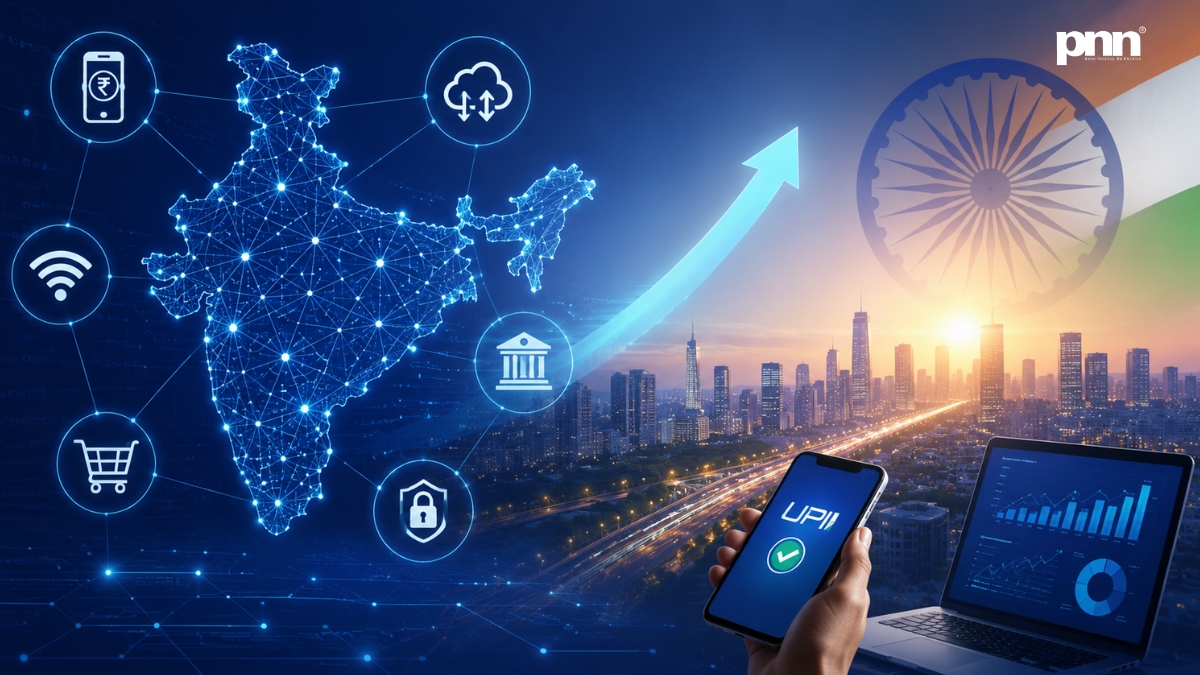
Mumbai (Maharashtra) [India], July 25: Walk into a vegetable market in Nagpur on any morning, and you’ll spot something that would have sounded like science fiction not too long ago. There’s a woman, selling tomatoes from her hand-cart, scanning a QR code taped to a piece of wood. A customer’s payment pings her phone before she’s even finished bagging up the veggies—and just like that, no one fumbles for cash or hunts for coins. It looks ordinary, but it isn’t. These mini miracles—playing out hundreds of millions of times across India every day—show that digital transformation isn’t just a buzzword anymore. It’s become the real engine of the economy.
The Payments Revolution Nobody Saw Coming
The Unified Payments Interface (UPI) powers this change. Today, India handles nearly half the world’s real-time digital payments. Back when UPI launched in 2016, nobody would have guessed it would get this big, this fast. The wild part? It’s not just techies in cities using it. Across the country, street vendors, auto-rickshaw drivers, shopkeepers—people who’d never touched a credit card—now pay and get paid digitally as if it’s second nature.
Before UPI, digital payments were pretty much locked behind credit cards or online banking, which left out most people. UPI tore down those walls overnight. Now, some of the fastest-growing user bases aren’t in Bengaluru or Mumbai at all—they’re in Patna, Indore, Coimbatore, and other places that used to be invisible on digital economy maps. Growth has finally stretched beyond the big cities, planting roots in places no one expected.
Building More Than Just Payments
But this isn’t just about UPI. If you look closer, you’ll see the bigger story. Take DigiLocker—a digital vault for government documents. Over 70 crore users save their certificates, licenses, and records here. A college applicant no longer lugs around a pile of photocopies; a driver just flashes a license on their phone instead of digging through their wallet.
And then there’s ONDC, the Open Network for Digital Commerce. The idea: do to e-commerce what UPI did for payments. Instead of relying on a few big online stores, any seller can join this shared digital marketplace. ONDC is still new and nowhere near as big as UPI yet, but it carries the same spirit—create a public digital backbone, and let businesses build on top.
Don’t forget the small towns and villages. Over the past ten years, optical fiber has been stretched to reach more than 2.15 lakh gram panchayats—about 97% of the target. There are now 6.5 lakh-plus common service centers and over a lakh post offices doubling as local digital access points. People can pay bills, apply for documents, or even talk to a doctor, all without traveling to the city.
How It’s Changing Work, Business, and Everyday Money
For small business owners, this isn’t just about fancy tech—it’s survival, and even a shot at real growth. A tailor in Lucknow who once relied on walk-in customers can now get orders from three neighborhoods away, thanks to a simple app. Out near Coimbatore, a poultry farmer checks prices on his phone before selling, not just trusting a middleman’s word anymore.
Families are rethinking money, too. Digital lending apps, despite causing some trouble early on, have opened up formal credit to millions who never had the paperwork to qualify before. Insurance is getting sliced up and served by the day—a delivery rider can buy a day’s accident coverage on an app, which made zero sense back when you had to sign up for bulky year-long policies.
Everything hasn’t gone perfectly. Data privacy is a real concern now that so much of life is online, and India’s new laws are still being tested. Some people—especially older folks or those in the remotest corners—still struggle with digital literacy, and not everyone finds it easy or comfortable to use an app or scan a QR code.
The World Is Keeping an Eye on India
What started out as an Indian story is turning into a global example. Around two dozen countries are now in talks with India, trying to figure out how to build similar “digital public infrastructure”—things like digital ID, payments, and document storage, run as public goods rather than private products. India even made this the centerpiece of its recent G20 presidency, pitching itself as proof that a huge country can leapfrog straight into the digital future rather than crawl forward bit by bit.
This global interest matters at home, too. Right now, the digital economy accounts for about 12 to 14% of India’s GDP, and government targets say it’ll almost double in the next decade. Whether that happens exactly on time isn’t the point. The real story is that more and more, India’s economy runs on phones, QR codes, and digital IDs instead of paperwork and face-to-face dealings.
The tomato seller in Nagpur isn’t thinking about statistics or global policy when she scans that QR code each morning. She’s just running her business. But in those everyday, invisible moments—millions of them, all over the country—India’s digital transformation is actually unfolding. Not in meeting rooms or policy papers, but right there on the hand-carts and in the outstretched hands of ordinary people.