

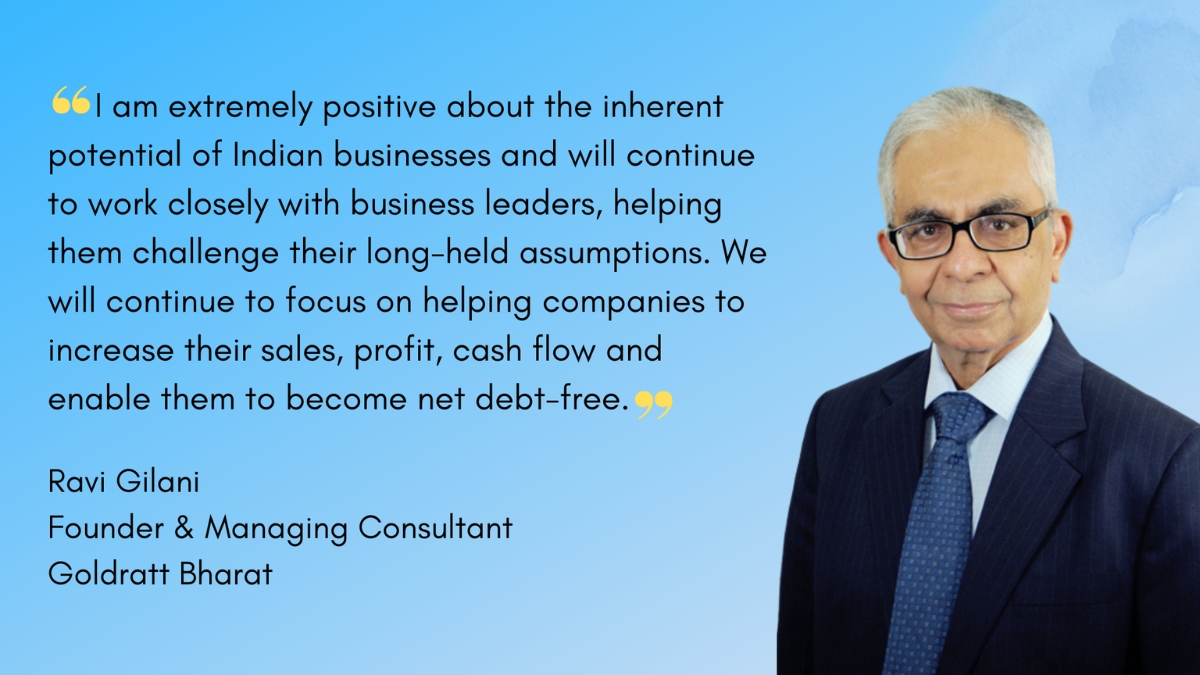
Ravi Gilani Founder & Managing Consultant, Goldratt Bharat
New Delhi [India], May 6: In an industry where business turnarounds are often linked to cost cutting and workforce reduction, a different approach has quietly taken shape over the past two decades. Instead of shrinking organisations to restore profitability, it focuses on improving how they function as systems. The result is not just recovery, but sustained growth.
The man who has continually enabled enterprises to do this is Ravi Gilani, Founder and Managing Consultant of Goldratt Bharat. Over 27 years, he has directly worked with more than 150 companies across sectors, building a reputation for turning around businesses without layoffs or heavy capital investment. His work has consistently focused on improving cash flow, delivery performance, and measurements alignment, increasing throughput rather than reducing scale.
A Different Starting Point
Most turnaround strategies begin with cost control. When companies face financial stress, the immediate response is to cut expenses, reduce headcount, and conserve cash. While this may provide short-term relief, it rarely addresses the underlying reasons for underperformance.
Ravi Gilani’s approach begins with a different question. Instead of asking what to cut, he asks what is limiting the system. This perspective is rooted in the Theory of Constraints, which treats organisations as interconnected systems governed by a single constraint at any point in time.
The implication is straightforward. Improving areas that are not constrained will not significantly change overall performance. Real impact comes from identifying and addressing the factor that is holding the system back. The constraint is not a negative word, it is a leverage point.
Constraints are not good or bad, they are facts of life. The output of the system will be limited by the constraint, whether it’s acknowledged or not. Knowledge of the constraint and managing it well enables companies to maximize throughput.
From Operations to Consulting
Before building his consulting practice, Ravi Gilani, an IIT Delhi alumnus, spent over two decades in operations at Tata Motors and Eicher. This experience shaped his understanding of how manufacturing systems function in reality.
On the shopfloor, problems are rarely theoretical. Delays in one area can affect production schedules, delivery commitments, and ultimately cash flow. These experiences highlighted a recurring pattern. Departments often performed well individually, but the system as a whole struggled to deliver consistent results. This gap between local efficiency and overall performance became a central theme in his later work.
Building a Track Record Across Industries
Through Goldratt Bharat, Ravi Gilani has applied constraint-based thinking across a wide range of industries, including automotive, metals, aerospace, retail, infrastructure, and financial services. The scale of this work is significant, with more than 150 companies engaged and over 200,000 professionals trained.
While each organisation presents unique challenges, the underlying issues often share similarities. Companies invest in improving processes, technology, and capacity, yet struggle with delivery reliability, excess inventory, and stretched cash cycles. These challenges are typically addressed through multiple parallel initiatives, which can dilute focus.
By identifying the constraint and aligning the measurements and reviews around it, the approach brings clarity in decision-making. Instead of spreading efforts across the organisation, it concentrates on the area that has maximum impact on the system output.
Multiplying Cash Velocity
One of the defining aspects of this work is the focus on cash flow. In many organisations, cash is treated as a consequence of sales order book and cost control decisions. In reality, it is often constrained by several decisions on what to produce, what to procure, how much to procure and several such daily decisions.
By improving flow across the system, organisations are able to reduce their cash to cash cycle time. This can help the company to rotate cash faster, and generate more cash in turn – improving cash velocity. It involves reducing inventory and receivables,shortening lead times, and aligning production with actual demand.
The impact of this approach is visible in large-scale transformations such as Jindal Steel. Over a multi-year period, the company achieved significant improvements in working capital reduction, profitability, and set new operational and financial benchmarks. Cash released through better system alignment enabled investment in growth and reduction of debt. Total employment increased by close to 30% during this period.
Similar patterns can be seen in mid-sized and smaller organisations. At Paharpur Group, the loss-making flexi packaging business was able to break even within months and sustain growth over the years. At Eicher Engineering Components, a division that had incurred losses for several years moved to sustained profitability and long-term expansion.
Looking Ahead
As businesses navigate increasing complexity, the need for clarity becomes more important. Investments in technology and processes will continue, but their impact will depend on how well they are aligned with the system’s constraint. The journey of Goldratt Bharat reflects an approach that prioritises outcomes over activity. By focusing on flow, improving cash velocity, and avoiding the reflex to cut costs through layoffs, it offers a different way to think about performance. For organisations seeking sustainable growth, the lesson is straightforward. Identify what is limiting you. Align around it. Improve it. The rest will follow.



 Divya Agarwal