

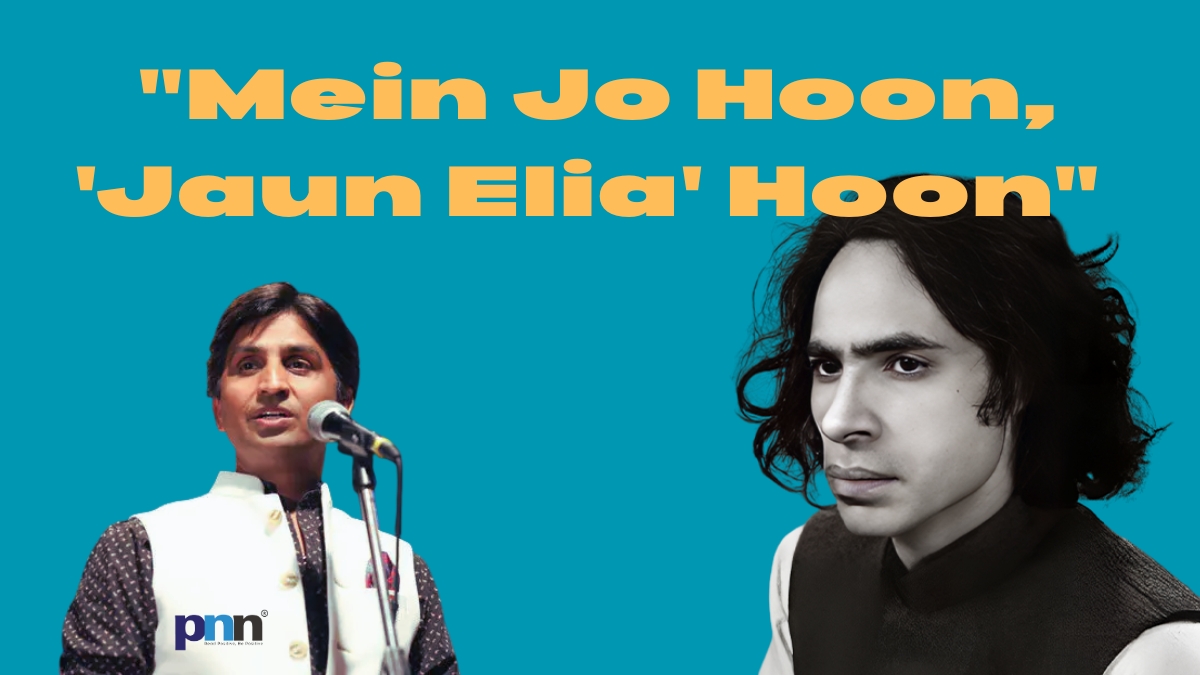
New Delhi [India], January 24: Jaun Elia did not arrive in India quietly. He arrived amplified. Through a microphone that was not his.
For most Indian readers under thirty-five, Jaun Elia did not come from libraries, serious Urdu study, or the long lineage of Progressive Writers. He came through Kumar Vishwas. That is not an insult. That is a logistical fact. Cultural transmission rarely cares about purity.
Vishwas didn’t reinterpret Jaun. He recited him. He named him. He repeated him on stages that reached places where Urdu poetry had not travelled in decades. Small towns. College auditoriums. Televised mushairas. You can dislike the circuit and still admit its reach. Without that reach, Jaun would have remained what he already was in India: a cult poet with no distribution.
This is how influence actually works. Not romantically. Practically.
Once the door was opened, Jaun Elia did the rest himself. He didn’t need an explanation. He needed exposure. Indian youth heard the lines and recognised the temperature immediately. Something colder than nostalgia. Sharper than heartbreak. A voice uninterested in emotional hygiene.
Jaun does not console. He doesn’t guide. He doesn’t even argue properly. He states. Then retracts. Then mocks his own statement. The effect is destabilising, which is precisely why it works on a generation raised on certainty masquerading as wisdom.
Take the lines that circulate endlessly now, usually stripped of attribution, floating free of context:
“Main bhi bohat ajeeb hoon, itna ajeeb hoon ke bas
Khud ko tabaah kar liya, aur malaal bhi nahin.”
I am strange—strangely so;
I ruined myself completely and felt no regret.
There is no lesson embedded here. No redemption arc. Just self-recognition without apology. That tone is rare in Indian public culture, which prefers either moral victory or emotional recovery. Jaun offers neither.
His popularity isn’t about sadness. That’s the surface reading. It’s about intellectual disobedience. He refuses to behave the way a poet is expected to behave. He doesn’t elevate pain. He interrogates it until it becomes tedious, then admits the tedium.
“Shayad mujhe kisi se mohabbat nahin hui,
Lekin yaqeen sab ko dilata raha hoon main.”
Perhaps I never loved anyone at all,
Yet I kept convincing everyone that I did.
This is not romance. It’s a self-indictment. And it lands hard among young readers exhausted by curated sincerity.
Jaun’s life feeds this voice, but doesn’t romanticise it. Born into scholarship, fluent across languages, burdened with intellectual inheritance—he still failed spectacularly at the basic logistics of living. Marriage collapsed. Politics disappointed him. Ideologies bored him. Migration gave him geography, not belonging. He never turned these failures into mythology. He left them raw, often embarrassing.
That honesty is abrasive. Indian youth recognise it because it mirrors their own private disillusionment. Not dramatic despair. Quiet erosion.
What Vishwas did—again, factually—is create the first large-scale Indian listening public for Jaun Elia. After that, social media finished the job. Clips became captions. Captions became passwords for emotional literacy. The poems detached from the stage and moved inward.
Jaun Elia now lives in phone screens at 2 a.m. Not as inspiration. As permission.
Permission to doubt one’s own feelings.
Permission to distrust slogans.
Permission to say “I don’t know” without packaging it as growth.
“Kya kaha ishq jawaan hai?
Abhi yeh bachcha hai.”
You say love is young?
No—it’s still a child.
This line circulates because it punctures the fantasy without replacing it. That’s Jaun’s entire method.
People worry about his effect on young minds. That he normalises despair. This misunderstands both the poet and the audience. Jaun didn’t create the disquiet. He gave it language. Sanitising that language would not make the disquiet disappear. It would only make it quieter and lonelier.
Jaun Elia does not want to heal anyone. He doesn’t offer exits. He doesn’t respect optimism enough to argue with it.
And Indian youth—introduced to him first by a voice they trusted, then claimed him on their own terms—didn’t ask him to.
They heard him.
They stayed.
That was enough.