
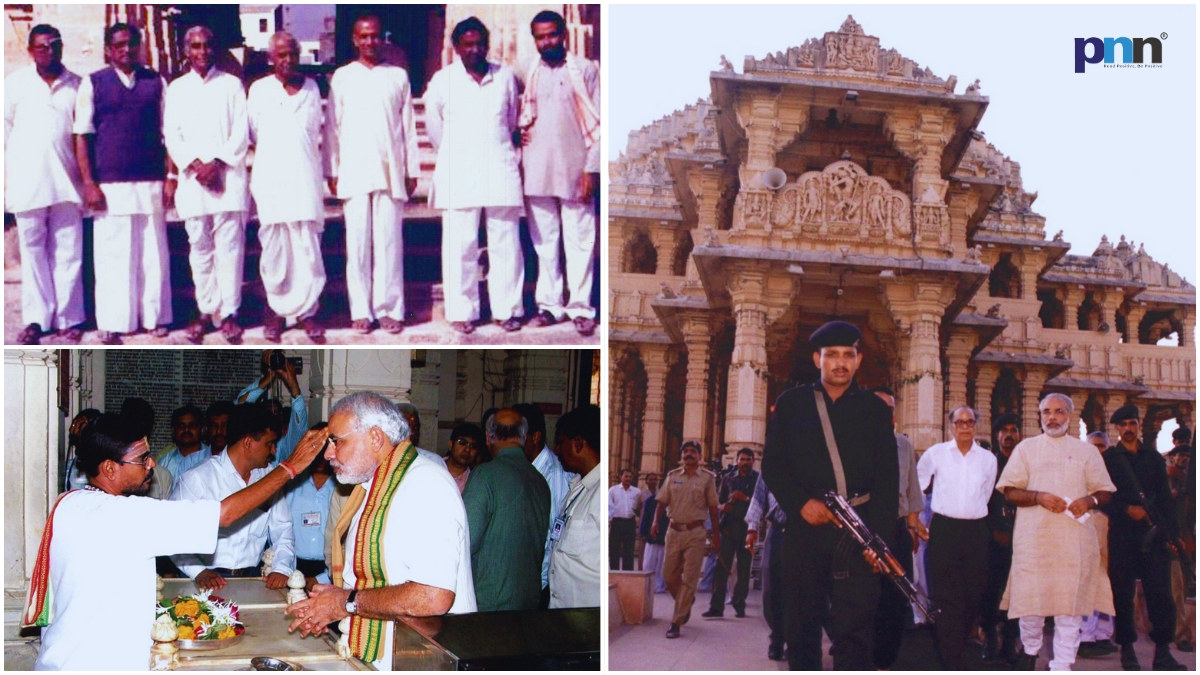
New Delhi [India], January 8: Some places are stone and mortar. Somnath is memory, muscle, and moral spine. As Somnath Swabhiman Parv begins, Prime Minister Narendra Modi is asking the nation to remember exactly that.
Somnath Swabhiman Parv officially commenced today, and with it came a message that cut through ceremony and nostalgia alike. Prime Minister Narendra Modi extended greetings to the nation, framing the occasion not as a ritual, but as a civilisational checkpoint. One that India has crossed, fallen at, rebuilt, and crossed again. Repeatedly.
The Prime Minister recalled that January 1026 marked the first attack on the Somnath Temple. It wasn’t the last. History records multiple assaults across centuries. Yet Somnath never vanished. It lingered in belief, in stories, in stubborn faith. And eventually, it rose again. Every single time.
That, PM Modi suggested, is the point of Somnath Swabhiman Parv.
Jai Somnath!
Somnath Swabhiman Parv begins today. A thousand years ago, in January 1026, Somnath faced its first ever attack. The attack of 1026 and the subsequent attacks couldn’t diminish the eternal faith of millions, nor break the civilisational spirit that rebuilt Somnath… pic.twitter.com/pfWqup532l
— Narendra Modi (@narendramodi) January 8, 2026
Somnath Swabhiman Parv is not Nostalgia. It’s Resolve.
According to the Prime Minister, Somnath Swabhiman Parv is about remembering the countless children of Bharat Mata who refused to compromise. Not on principles. Not on ethos. Not even when the odds were brutal.
His words were blunt and deliberate. The attacks did not break the faith of millions. They did not erase the civilisational spirit that rebuilt Somnath again and again. That spirit, PM Modi implied, is still alive. Still relevant. Still necessary.
This is where Somnath Swabhiman Parv moves beyond history textbooks. It becomes about continuity. About the idea that civilisation is not inherited passively. It is defended, rebuilt, and reaffirmed.
A thousand years later, the message lands with precision.
A temple rebuilt, a nation reaffirmed
PM Modi also looked back at a defining modern chapter in Somnath’s story. On 31 October 2001, a major programme was held at Somnath to mark 50 years since the rebuilt temple opened its doors in 1951. That reopening, attended by India’s first President Dr Rajendra Prasad, was itself a statement. Quiet, constitutional, and firm.
The reconstruction of Somnath did not happen in isolation. PM Modi highlighted the pivotal role played by Sardar Vallabhbhai Patel, KM Munshi, and several others who ensured the temple’s revival after Independence. This wasn’t about symbolism alone. It was about restoring civilisational confidence in a newly free nation.
The 2001 programme also coincided with the 125th birth anniversary of Sardar Patel. The guest list reflected the gravity of the moment. Prime Minister Atal Bihari Vajpayee. Home Minister Lal Krishna Advani. Senior leaders. Public figures. A collective acknowledgement that Somnath mattered. Still does.
Somnath Swabhiman Parv, in that sense, stitches together 1026, 1951, 2001, and now 2026. Different centuries. Same spine.
Why 2026 matters?
Prime Minister Modi drew attention to the year ahead. 2026 will mark 75 years since the grand rededication ceremony of 1951. Three-quarters of a century since Somnath was formally returned to the nation as a living temple, not a relic.
PM Modi was clear. This milestone is not just about architecture or restoration. It is about the indomitable spirit of Indian civilisation. A spirit that absorbs shocks, refuses erasure, and keeps moving forward.
In today’s India, where cultural confidence is increasingly part of public discourse, Somnath Swabhiman Parv fits squarely into the larger narrative. It reinforces the idea that heritage is not ornamental. It is foundational.
The Prime Minister’s Subhashitam and its quiet message
Alongside the greetings, PM Modi shared a Subhashitam, a traditional Sanskrit verse, praying for the welfare of all citizens. It was understated. No theatrics. Just a reminder that India’s civilisational vocabulary has always balanced strength with collective well-being.
That balance matters. Somnath Swabhiman Parv is not framed as exclusionary. It is framed as civilisational memory with universal welfare at its core.
Social media, memory, and modern participation
In a series of posts on X, the Prime Minister shared glimpses from his previous visits to Somnath. He invited citizens to do the same, encouraging them to share their own memories using the hashtag #SomnathSwabhimanParv.
This wasn’t incidental. It was participatory history. A way of saying that Somnath does not belong to archives or officials alone. It belongs to devotees, travellers, families, and first-time visitors who stood quietly before the sea-facing shrine and felt something difficult to explain.
The posts revisited the attack of 1026, the repeated assaults that followed, and the fact that none of them succeeded in extinguishing faith. The tone was firm, not angry. Reflective, not defensive.
That restraint is deliberate. It keeps the focus on resilience, not grievance.
Why does Somnath still speak?
For India, Somnath is not an isolated monument in Gujarat. It is part of a larger conversation about civilisational continuity. About remembering without becoming trapped by resentment. About rebuilding without forgetting why rebuilding was necessary.
In an era where identity debates are loud and often messy, Somnath Swabhiman Parv offers a quieter anchor. It says pride does not require shouting. Memory does not require bitterness. Resolve does not require an apology.