
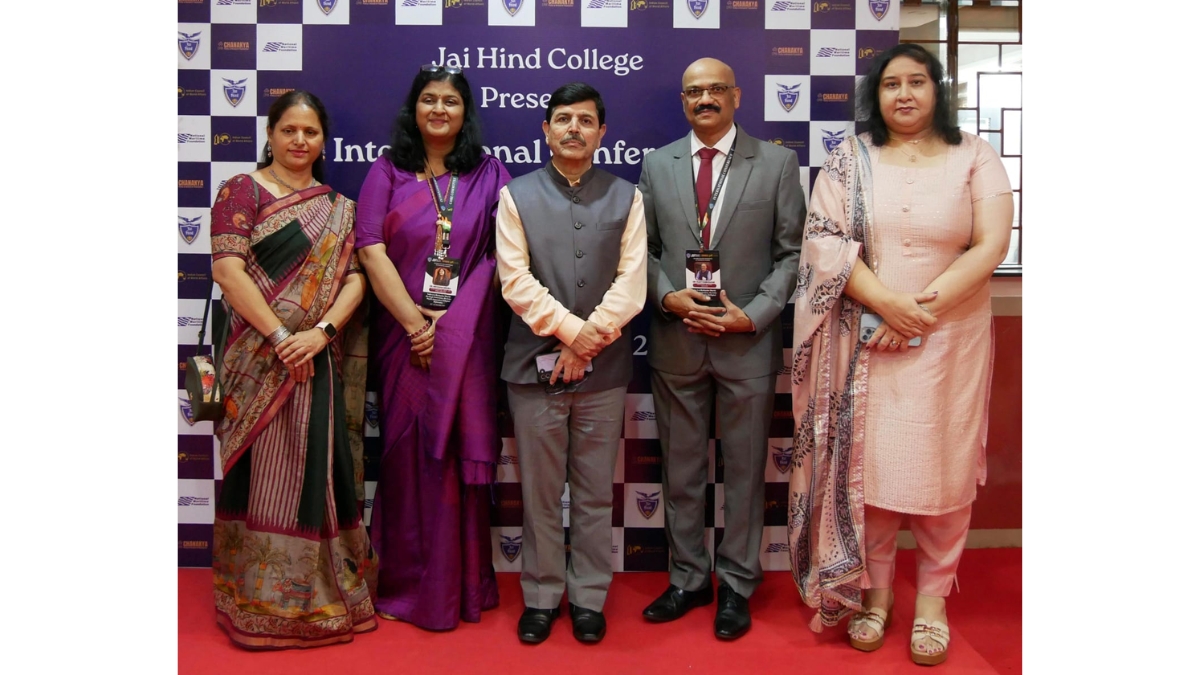
Mumbai (Maharashtra) [India], December 12: Jai Hind College, Mumbai, in collaboration with the Indian Council of World Affairs, Chanakya Policy & Research Foundation and the National Maritime Foundation, inaugurated a high-level three-day International Conference titled “India in Multipolar World Order.” Led by Principal Dr. Vijay Dabholkar and Convener Dr. Archana Mishra (Vice Principal, Arts), the conference brought together diplomats, defence leaders, scholars and industry experts to assess India’s strategic trajectory in an increasingly complex global environment.
Opening the conference, Prof. Ravindra Kulkarni, Vice-Chancellor of the University of Mumbai, invoked the ancient ethos of Vasudhaiva Kutumbakam — the world as one family. He emphasised that rapid technological advancements and real-time communication are accelerating the global transition toward a multipolar order.
Representing international cooperation, Ms. Avishag Hefer, Deputy Consul General of Israel, highlighted Israel’s longstanding partnership with India, particularly in agriculture and innovation, and noted India’s expanding soft-power projection worldwide.
Delivering the keynote address, Lt. General Vinod Khandare (Retd.), former Principal Advisor, Ministry of Defence, called for revisiting classical strategic thinkers and India’s own civilizational wisdom to navigate contemporary geopolitical flux and shifting power dynamics.
A session on strategic autonomy featured Dr. Sreeram Chaulia of the Jindal School of International Studies, who described India’s foreign policy as “pragmatic multipolarity,” enabling robust ties with Russia, Japan, France and others even amid intensifying global rivalries.
From an industry lens, Mr. Kashish Parpiani of Reliance Industries Ltd. argued that the world economy is undergoing “re-globalisation,” with economic networks shifting rather than shrinking.
Regional security and India–China dynamics formed another major highlight. Mr. R.N. Bhaskar presented the Russia–India–China (RIC) triangle as a complementary strategic structure — India as a large market, China as a technology-and-capital provider, and Russia as a key resource partner.
Dr. Rajiv Ranjan contrasted China’s relational diplomatic approach, rooted in Qin Yaqing’s theory, with India’s mandala-inspired geopolitical tradition, suggesting India’s framework more effectively safeguards national interest. Scholars also underlined persistent tensions — border disputes, maritime competition and strategic mistrust — that continue to impede meaningful cooperation between India and China.
The day concluded with a vibrant cultural showcase featuring classical music and regional performances including Rajasthani folk, Garba, Lavani and South Indian dance traditions, celebrating India’s cultural diversity.
Honouring the occasion as Chief Guest, Mr. Bhushan Gagrani, IAS, Municipal Commissioner of the Brihanmumbai Municipal Corporation (BMC), praised the initiative, stating that “such platforms equip young scholars to understand fast-changing geopolitical and governance transitions.” He emphasised that multidisciplinary thinking is essential for navigating today’s unpredictable global landscape.
If you object to the content of this press release, please notify us at [email protected]. We will respond and rectify the situation within 24 hours.