
New Delhi [India], October 18: India isn’t just flexing muscle; it’s rewriting the playbook. From missiles that reach every inch of Pakistan to AI that could transform global healthcare, New Delhi is putting the world on notice: this is what self-reliance looks like when it gets serious.
Rajnath’s Message: “Every Inch Within Range”
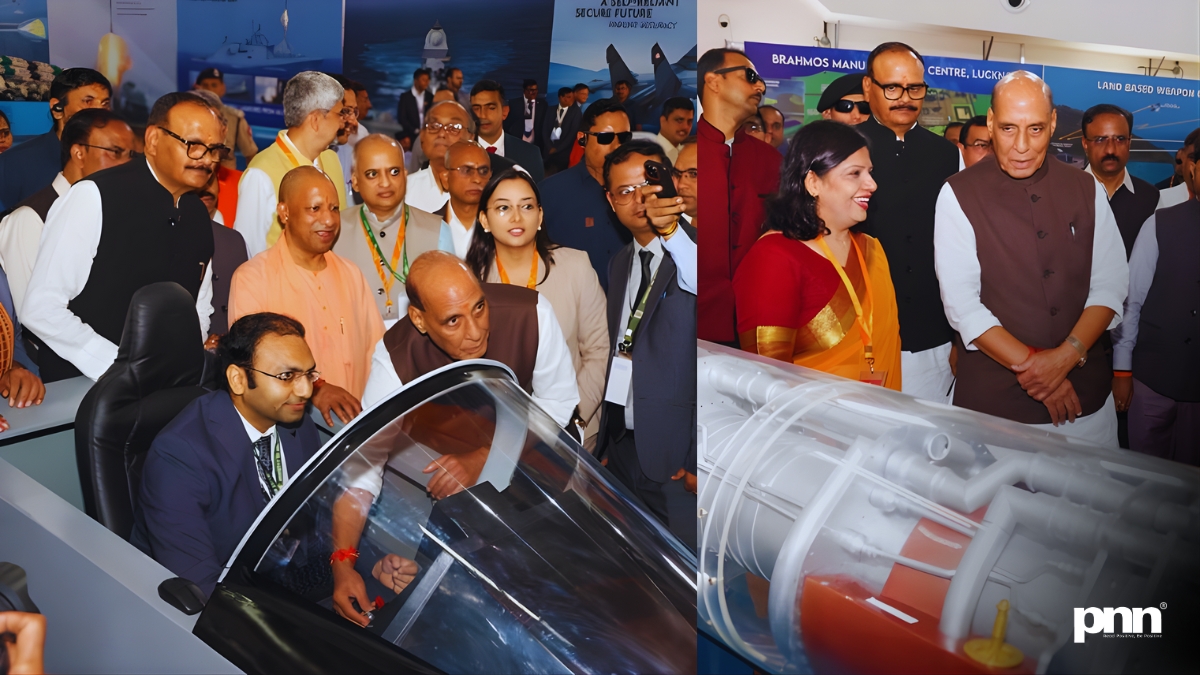
In Lucknow, Defence Minister Rajnath Singh delivered a message that left no room for ambiguity. At the BrahMos Aerospace unit in Sarojini Nagar, he declared that “every inch of Pakistan’s territory lies within range of BrahMos.” What unfolded during Operation Sindoor, he warned, was “just a trailer.”
Flanked by Uttar Pradesh Chief Minister Yogi Adityanath, Singh flagged off the first batch of BrahMos missiles manufactured in Lucknow, an unmistakable milestone for India’s defence ecosystem. “BrahMos isn’t just a missile. It’s proof of India’s strategic confidence,” he said.
For the record, BrahMos is a supersonic cruise missile developed jointly by India and Russia. It’s deployed across all three services, Army, Navy, and Air Force, and has become India’s go-to weapon for precision strikes.
Operation Sindoor, carried out earlier this year, saw India destroy terror infrastructure and defence installations inside Pakistan using indigenously produced BrahMos missiles. The trigger was an attack in Jammu and Kashmir’s Pahalgam on April 22 that killed 26 people. The swift retaliation wasn’t just a military statement; it was a masterclass in deterrence.
Singh didn’t mince words. “Victory has become a habit for us,” he said, adding that Operation Sindoor “instilled new confidence among Indians and proved BrahMos’ effectiveness to the world.”
Lucknow Joins the Defence Big League
The newly operational BrahMos Integration and Testing Facility in Lucknow is not just a factory; it’s a symbol of how far India has come in turning intent into industry. Inaugurated virtually in May, the 200-acre site now produces up to 100 missile systems annually, with all integration and testing done locally. The ₹380-crore project under the Uttar Pradesh Defence Industrial Corridor (UPDIC) is expected to clock a turnover of ₹3,000 crore by the next fiscal year, generating ₹500 crore in GST alone.
Yogi Adityanath called it a “shining example of the Make in India vision,” adding that over 15,000 youth have already found jobs across UPDIC’s six nodes. He didn’t need to say the quiet part aloud; this is what an industrial policy looks like when it works.
Singh added that BrahMos is now not just India’s backbone but a global brand, pointing to recent contracts worth ₹4,000 crore signed with two countries. “India is now a giver, not just a taker,” he said, calling the missile export deal to the Philippines just the start of a new chapter.
And then came the punchline only Rajnath Singh could deliver: “If India could create Pakistan, then you all are wise enough to know what we can do if the time comes.”
Subtle? Not really. Effective? Absolutely.
From Missiles to Machines That Heal
If BrahMos shows India’s ability to hit targets, the IndiaAI–WHO partnership proves it can also heal the world. Hours after Rajnath’s fiery address, another arm of the Indian government, the Ministry of Electronics and IT, announced a collaboration with the World Health Organization.
Their joint initiative, the Casebook on AI Health Use Cases Across the Global South, is not about weapons; it’s about wisdom. The goal: document real-world AI applications in healthcare that actually work and can be replicated worldwide.
Researchers and innovators across developing nations have until October 31, 2025, to submit abstracts showcasing AI solutions that have improved healthcare delivery, diagnosis, or disease management. Selected entries will feature in a Casebook to be launched at the India–AI Impact Summit 2026 in New Delhi this February.
For India, it’s another quiet assertion of leadership. The same country that once imported almost everything is now setting global standards in AI ethics, scalability, and responsible innovation.
This isn’t charity, it’s strategy. The Casebook will act as a reference for policymakers and health innovators across the Global South, offering a roadmap to replicate India’s digital health success.
The Casebook will highlight deployable, ethical, and scalable AI projects that have transformed real-world health systems. Full chapters, due by December 15, will detail implementation strategies, impact metrics, and lessons learned.
India’s Twin Engine: Power and Purpose
Put together, these two developments tell a single story: India isn’t waiting for permission anymore. Whether it’s defence technology that rattles adversaries or AI systems that inspire international collaboration, the message is the same: India’s tech ambitions are real, strategic, and unapologetically global.
The BrahMos facility shows what happens when policy, engineering, and political will align. The IndiaAI–WHO Casebook shows how that same model can be exported to address global healthcare gaps. One secures borders; the other saves lives. Both serve the same vision, Aatmanirbhar Bharat, powered by innovation.
Lucknow might soon host visiting defence delegations, while Delhi hosts health-tech pioneers. Different stages, same script: India leading by design, not chance.