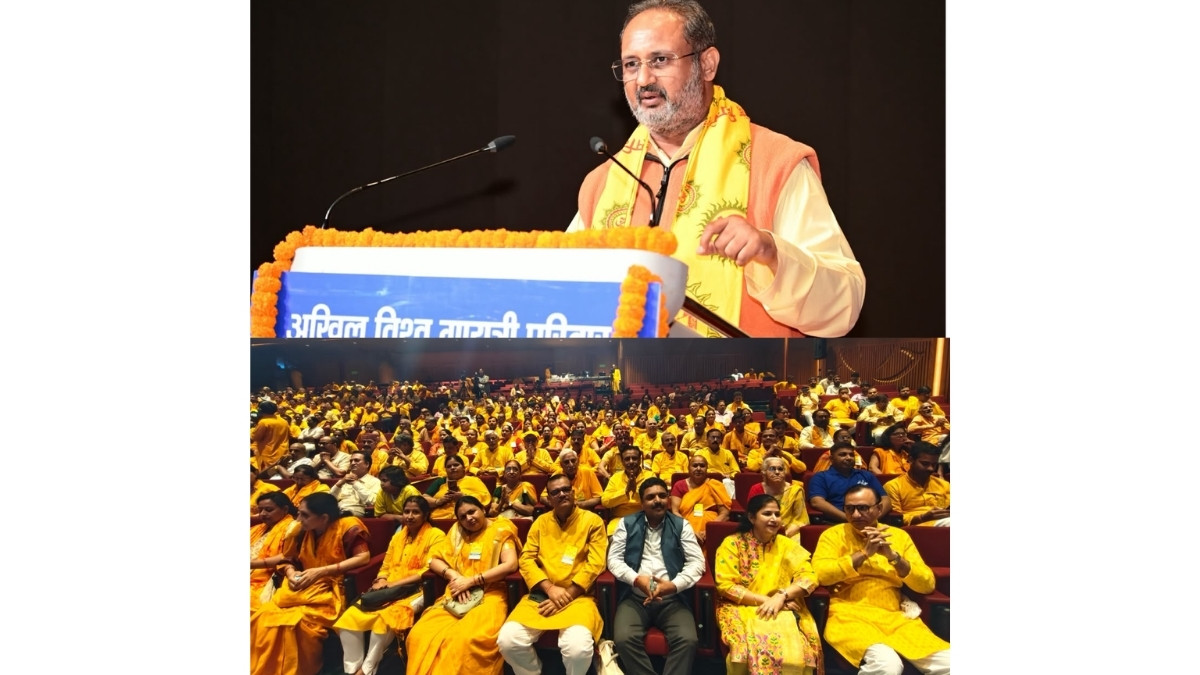


New Delhi [India] October 7: Her tomb is still to be seen where she fell, in a narrow defile between two hills, and a pair of large rounded stones that stand nearby are, according to popular belief, her royal drums turned into stone, which in the dead of night are still heard resounding through the woods and calling the spirit of her warriors from their thousand graves around her. — Sir William Henry
Rani Durgavati, the indomitable queen of Gondwana, is revered for her deft combat strategies, valor, and sacrifice. Additionally, her pioneering contributions to a methodical tax collection system, efficient governance, and public welfare are noteworthy. Her reign extended to present-day Bhopal, Sagar, Narmadapuram, Jabalpur, and certain divisions of Bilaspur and Nagpur. Today marks the 500th anniversary of Rani Durgavati’s birth. Compared to the likes of Kakatiya queen Rudrama Devi and Joan of Arc of France, she emerged victorious in 51 of the 52 battles she fought. An allegory of great courage, she sacrificed her life to protect and uphold her nation as well as Dharma.
She was adept in nine traditional military formations, excelling particularly in the Kraunch and Arambhan formations. The Kraunch formation was designed for large armies, where the wings held the troops, and the queen herself led from the beak. The Arambhan formation was employed when a smaller force had to counter a larger one. The modern “Force march formation” used by military forces today is derived from these ancient tactics.
She was born on 5th October 1524, on the day of Durgashtami, in the fort of Kalinjar to King Shalivahan Kirat Singh and his wife, Kamalavati. Impressed by her panache, modesty, wit, and bravery, the king of Gondwana, Sangram Shah Maravi, proposed to the Chandel king Kirat Singh to marry his daughter to his son, Dalpit Shah, which was accepted. This marriage was an exemplary paradigm of social harmony.
A few years into her marriage, upon the untimely death of her husband, King Dalpit Shah, Queen Durgavati assumed control of the Gondwana Kingdom as the guardian of her five-year-old son, Veernarayan. Thus, the heroic Queen Durgavati of Gondwana emerged as its ruler. The 16 years that followed are considered the golden age of Gondwana, marked by a well-organized Panchayat system that governed political, social, economic, religious, cultural, and artistic matters. During Queen Durgavati’s rule, a systematic and planned Panchayat structure was implemented, making Gondwana the only state in erstwhile India where taxes were paid in gold coins and elephants. The region boasted a developed textile industry, and the trade of herbal medicines was promoted.
The brave queen’s sustainable water management and environmental protection plans remain as relevant today as they were then. Under her aegis, thousands of ponds and stepwells were constructed.
The Panchasar Yojana, a unique system of 52 lakes and 40 stepwells, was created in Jabalpur. There were three different kinds of lakes: urban lakes, Terai lakes for water storage at the foothills, and hill lakes for the health of the forest and wildlife. There were underground waterways connecting these, and scientific methods were employed for water conservation. Gondwana was known for its sophisticated agriculture, a profusion of cattle, and the widespread popularity of its coarse grains (millets) throughout India. There was vigorous promotion of the cotton, coal, herbal medicine, and forest industries. Industries including lac, medicine-making, honey, fodder, and cow dung were fostered in forested areas. Mango, jamun, custard apple, and guava gardens were created in urban areas, and trees such as sal, teak, khair, tendu, and mahua were planted and preserved in rural areas. The development of water resources fueled the production of Santra and maize. In addition, Queen Durgavati made significant advances in women’s emancipation. She founded the first children-focused Gurukul at Pachmatha, close to Devtal, and refurbished Golki Math, a Kalchuri-era technical institution in Bhedaghat that offered instruction in Sanskrit, Prakrit, and Pali languages.
Queen Durgavati received a menacing letter from Akbar sent by Nawab Asaf Khan of Banda, that read:
“अपनी सीमा राज की
अमल करो परवान
भेजो नाग सुपेत सोई
और आधार दीवान”
It is said that Queen Durgavati sent Akbar a golden stick (to make cotton) with the note, “Your task is to make the cotton.” In response to his message, furious Akbar sent Asaf Khan, the Nawab of Banda, to attack Gondwana. A severe defeat was faced by Asaf Khan in the First Battle of Singaurgarh. However, the Mughal artillery proved too strong in the Second Battle of Singaurgarh, and the queen was forced to flee the fort. In order to protect her men from the Mughal artillery, she set up a defensive position in the thick Narrai Nala forest in Barela, modern-day Jabalpur.
Thrice, the brave Gonds successfully resisted an attack by the Mughals. The Mughals responded with an artillery attack. According to her plan, Queen Durgavati started to withdraw into the thick trees. But then the cunning Badan Singh betrayed her, bursting the hilltop lake, flooding Narrai Nala, and spreading mayhem. Queen Durgavati boldly continued the battle even though an arrow had injured her eye. An unexpected arrow struck the queen’s throat, scattering the Mughal troops. Commander Adhar Singh ordered the soldiers to move away from battle and tried to save the queen. As the brave Queen Durgavati realized she would not survive, she prepared to make her last move. With her own dagger, the brave queen took her life, declaring,
“Everyone dies, Adhar Singh, but history remembers only those who lived and died with dignity.”
https://en.wikipedia.org/wiki/Himadri_Singh
If you have any objection to this press release content, kindly contact [email protected] to notify us. We will respond and rectify the situation in the next 24 hours.


 Divya Agarwal